All shipping services for handheld lasers and flashlights on wickedlasers.com and flashtorch.com are suspended indefinitely until further notice. LaserCube shipping is unaffected. Click here to sign up for email updates.
Laser beam collimating is regarded as a technical marvel and optical art form that has become a Wicked Lasers specialty. Our technicians are highly skilled professionals that have dedicated themselves to research and development in the area of 532nm DPSS laser technology in order to provide exciting and world renowned laser beam products.
Built to world-class specifications and leading ISO standards, Wicked Lasers has literally reached the clouds and aims for the stars with its products by introducing the world's most elite sub-compact OEM laser beam unit available.
Laser enthusiasts all over the world are amazed at Wicked Laser performance, stability and size. For the money, nothing on the market compares to our size format and rated beam output. Each laser we sell is hand-tested, assembled and packaged by trained professionals. High quality and beam propagation control allows Wicked Lasers to build extremely powerful and ultra compact laser units at an economical price.
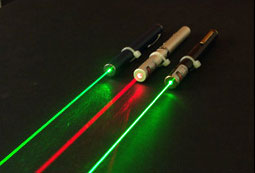
Wicked Lasers offers a variety of laser products, which produce either a green or red beam of light. Depending on the use and industry, you can be certain whatever laser you purchase through Wicked Lasers will be the highest-quality product for your needs. For more information on the lasers we carry including specifications of the red and green beams, click to view our products page.
untitled
Beam Diameter/Beam Divergence
Beam diameter and beam divergence are the two most important technical specifications involved in choosing a laser.
Beam diameter simply refers to the diameter of a laser beam, usually measured in millimeters. Beam divergence measures how much a laser beam expands per meter. For example, a laser with a beam divergence of 1.0mRad will have its beam expanded by 1.0mm per meter.
How do these two specs relate to each other, and more importantly, why do they matter?
It all comes to how small the little dot (the diameter size of your leaser beam) is at certain distances. This affects how far away you can point and see the beam and how much power it will have, for example to burn through things.
Common sense tells us that if a laser beam diameter is small, it can go further and burn with more power. Ideally, you want to have small beam diameter at aperture and small beam divergence.
The limitations determined by the laws of photonics -- nature dictates that we can't get something for nothing -- is that you can't have both a small beam diameter and small beam divergence at the same time. It's a trade-off.
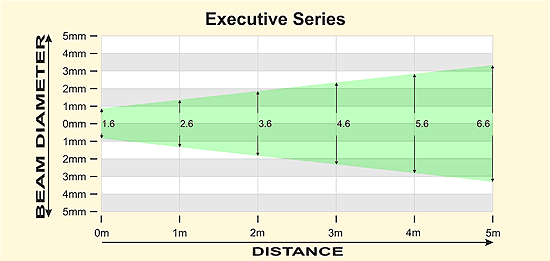
For example, compare the Nexus 95 (Executive Series) and an Evo 95 in the table at the bottom of the page. We know that Nexus has a beam diameter of 1.6mm at aperture and beam divergence of 1.0mRad. The specs for Evo 95 are 0.8mm and 1.5mRad respectively.
At aperture, the Evo 95mW has one half of the beam diameter of Nexus 95mW. That means with equal power output, it has four times as much burning power as Nexus (burning power is proportional to area, which is proportional to the square of the diameter)!
However, at a distance of two meters, Nexus 95mW catches up and surpasses the Evo 75mW. At exactly two meters, Nexus 95mW has a smaller beam diameter than Evo 75mW. At five meters, the difference in beam diameter gets larger (8.3-6.6 = 1.7mm) although still hard to noticea. The conclusion here is that the Executive Series is better for long distance pointing.
The Evolution Series, while maintaining a decent performance in terms of far range pointing, focuses more on burning power than the Executive series.
Click on the individual lasers below to see characteristics for different lasers yourself!
*Physical Beam diameter can not be less than zero. The actual physical diameter for a beam diameter of -4.5mm is 4.5mm (the absolute value of -4.5mm). Why negative? because Pulsar series is very different - its beam diameter is actually shrinking right after it leaves the laser lens whereas all other lasers we carry have beams expanding right off the laser lens.
*Remember, use lasers with care. See our Wicked Gear page for information about safety goggles and other laser accessories.


)
)
)
)
)
)
